Content
DPMAnutzerforum 2026: quantum technology is gaining momentum

DPMA analysis: sevenfold increase in patent applications relating to quantum technology compared to ten years ago – German applicants in second place behind US applicants – DPMA President: Germany could be co-shaping crucial innovations – potential of quantum technology for Germany key topic at the DPMAnutzerforum in Munich
Press release of 16 March 2026
Munich. Quantum technology is regarded as the next key technology with a high potential for change, similar to artificial intelligence – and innovative activity in this area has been gaining considerable momentum: in the past ten years, the number of patent applications relating to quantum technology for the German market has increased almost sevenfold. A large number of these applications come from companies and research institutions from Germany, as can be seen from an analysis conducted by the German Patent and Trade Mark Office (DPMA) on the occasion of this year’s DPMAnutzerforum. Once again, IP experts from industry, law firms, service providers and science as well as from the Federal Ministry of Justice and Consumer Protection will come together on March 17 and 18 in Munich at the DPMA’s biggest annual event. The DPMAnutzerforum will focus on the potential of quantum technologies for Germany and the central importance of the protection of related innovations. Visit the  YouTube channel of the DPMA to follow the DPMAnutzerforum online.
“Even though the development certainly is only at an early stage, we are already seeing an immense innovative dynamism in quantum technology,” DPMA President Eva Schewior said. “With its excellent research institutions, strong industrial enterprises and innovative start-ups, Germany has enormous potential to co-shape crucial quantum technology innovations. We have to translate this potential into attractive products and business models. IP protection, in particular by patents, is an important prerequisite for this.”
Complex calculations, tap-proof communication, ultra-precise measurements
Quantum technologies use the special physical characteristics of microparticles such as atoms, electrons or protons to process, transfer or make extremely precise measurements of information in a completely new way. This opens up a variety of new application areas, from high-performance quantum computers, which could enable complex calculations in materials research or the development of active substances, to tap-proof quantum communication to highly sensitive quantum sensors, which can be used in navigation, medicine or environmental measurements, for instance.
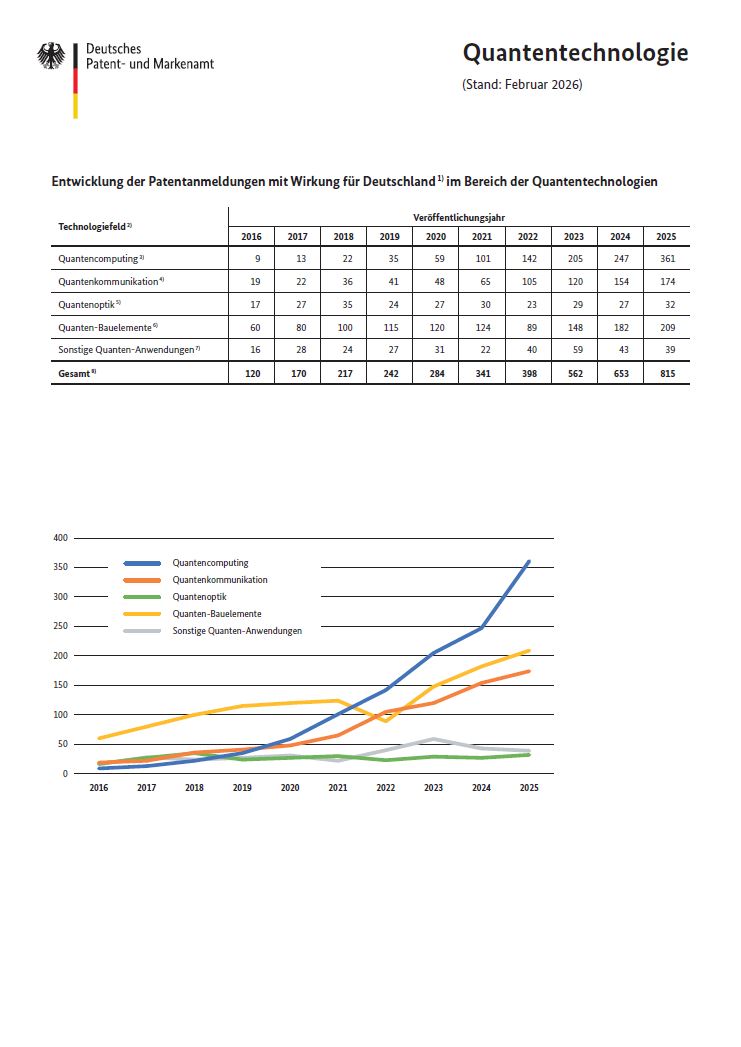
Development patent applications
The total number of patent applications in this technological field is still relatively low, but there is a strong dynamism: last year, the DPMA and the European Patent Office published 815 patent applications with effect in Germany relating to quantum technology; ten years earlier, the number was just 120. The increase was particularly strong with respect to quantum computing, which is by far the strongest segment now, at 361 applications. Quantum computing was followed by the quantum components segment, which includes individual components needed for quantum computers (209 applications), for instance. Quantum communication came in third (174 applications).
(Please also see our  Fact sheet "Analyse Quantentechnologie")
Asian groups of companies lead the ranking of applicants
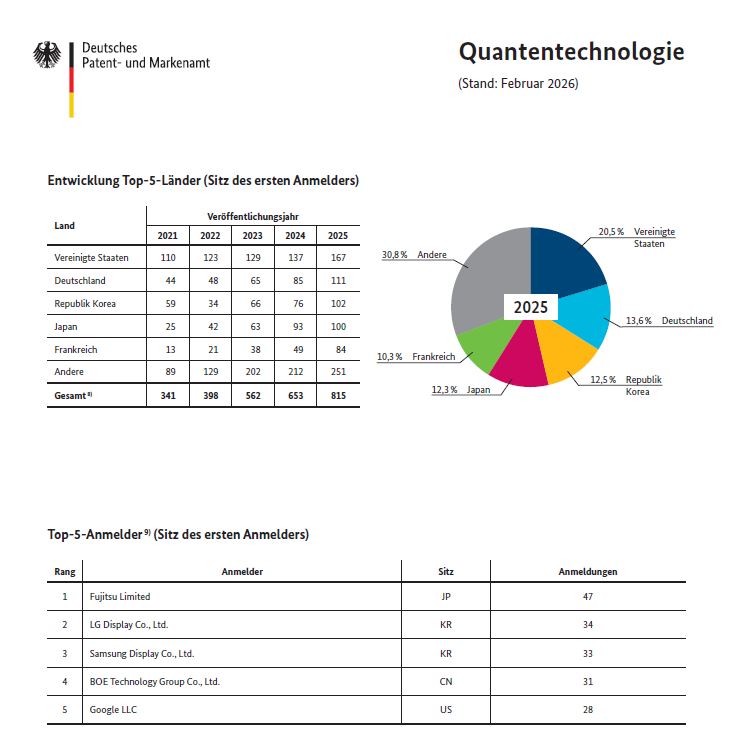
Country ranking
Last year, most publications came from the United States of America (167), ahead of Germany (111) and the Republic of Korea (102). Japan (100) and France (84) were fourth and fifth, respectively, in the international ranking.
In the ranking of applicants for the German market, there was no German company among the top 5. The Japanese company Fujitsu Limited (47 applications) took first place, ahead of the Korean companies LG Display Co., Ltd. (34), and Samsung Display Co., Ltd. (33). The Chinese BOE Technology Group Co., Ltd. (31), and the US digital group Google LLC came in fourth and fifth, respectively. For groups of companies, quantum technology is one of many fields of activity. But in the past years, specialised start-ups have been established that also significantly contribute to innovation and file patents.
Important: For the analysis concerning digitisation, we considered published patent applications with effect in Germany at the DPMA and at the European Patent Office, without double counting. Patent applications are published after 18 months. Accordingly, inventions newly filed in 2025 are not included in the analysis.
How does this benefit Germany? Debate at the DPMAnutzerforum
The DPMA expects several hundred people to join the DPMAnutzerforum 2026 again at its office and on the livestream. The DPMA President will present current application trends, and Peter Berg, Chief IP Counsel at Infineon Technologies AG and Chair of the Board of Directors of the Association of Intellectual Property Experts, will deliver a keynote on the potential of quantum technology from industry’s point of view. Furthermore, experts from specialised quantum technology start-ups will speak about the crucial step from research to industrial application, and Dr Johannes Christian Wichard, of the Federal Ministry of Justice and Consumer Protection, will report on the latest trends in IP law. In addition, experts will discuss how IP rights can strengthen Germany as an innovation hub.
The German Patent and Trade Mark Office
Inventiveness and creativity need effective protection. The DPMA is the German centre of expertise for all intellectual property rights – patents, utility models, trade marks and designs. As the largest national patent office in Europe and the sixth largest national patent office in the world, our office stands for the future of Germany as a country of inventors in a globalised economy. Its staff of around 2,800 at three locations – Munich, Jena and Berlin – provide services to inventors and companies. They implement federal innovation strategies and develop the national, European and international protection systems.
Bild: ©623682717_MARK GARLICKSCIENCE PHOTO LIBRARY via Getty Images
Last updated: 16 March 2026
Not only protecting innovations
Social Media