
Content
Smart goals, smart shin guards and robots that collect balls
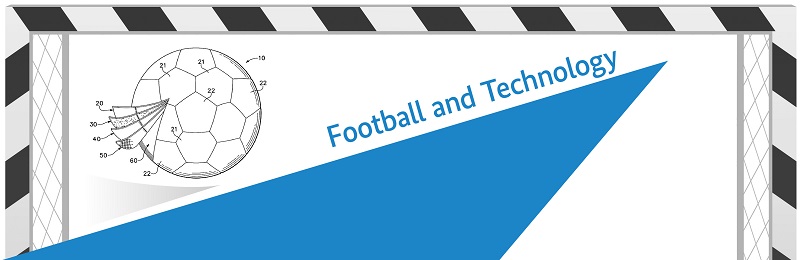
The ball remains round for the World Cup – and technical innovations continue apace. To mark the World Cup in Canada, Mexico and the USA, the German Patent and Trade Mark Office has expanded its online gallery ‘Football and Technology’. As well as much-discussed innovations such as goal-line technology and video replays, there are also a number of lesser-known inventions designed to improve the game in the future. Are there any groundbreaking ideas among them? It’s definitely worth taking a look at the gallery.
Press release of 26 May 2026
Munich. Robots that collect balls and take shots themselves. Artificial intelligence (AI)-controlled safety nets that protect spectators in the stadium. Ground-mounted goals that can be easily moved for training sessions. Technical innovations in professional and grassroots football today often rely on digital technologies – or make creative use of mechanical principles. Ever since this ball sport was invented, creative minds have been working on solutions to improve players’ performance, make equipment a better fit, and make football matches more appealing to spectators. ‘Football and technology: how inventions shape professional and grassroots sport’– under this theme, the German Patent and Trade Mark Office (DPMA) is exhibiting patent documents from around the world and providing commentary and explanations on inventions relating to all aspects of the game. To mark the Football World Cup, which kicks off on 11 June in Canada, Mexico and the USA, we have expanded the collection to include the latest innovations. The gallery, which spans some 125 years of innovation, also features detailed information on modern classics such as goal-line technology and video refereeing, as well as numerous examples from the never-ending quest for the perfect boot.
“The history of football technology is fascinating – and our gallery explores this history in detail. There are also a few innovations to discover that could shape future tournaments. The spectrum of innovations spanning 125 years ranges from the first balls and studded boots to robotics and artificial intelligence on the pitch,” says DPMA President Eva Schewior. “The gallery demonstrates that, in football too, the protection of innovations has always been a key means of harnessing the economic potential of inventions.”
From the ball and the goals to rule enforcement and data analysis – the gallery is divided into ten sections and a special feature. Inventors are particularly active when it comes to recording and analysing biometric data to improve performance. Every movement and every part of the body is to be monitored using sensors – housed, for example, in shin guards or a hip belt – so that suggestions for improvement can be developed later and training optimised. Some of these inventions are also designed to recreate professional football in computer games as faithfully as possible using electronic data. Artificial intelligence is also becoming increasingly prevalent in football – whether for analysing player data, monitoring and evaluating a match for the audience, or protecting spectators from balls struck with great force into the stands. The square object in the game, the goal frame, also inspires innovation: From algorithmically controlled lighting of individual areas, which enables targeted training, to floor balls that allow goal frames to be moved and secured with ease.
There is also plenty going on on the pitch itself. A number of recent developments focus on turf management: drones could carry out watering from the air, whilst self-learning systems could determine maintenance requirements based on environmental data. In many stadiums around the world, however, matches are no longer played on natural grass but on so-called hybrid turf. It is designed to combine the durability of artificial turf with the excellent playing characteristics of a natural surface. You can find some interesting innovations in this area in our gallery. When it comes to boots, manufacturers seem to be engaged in a never-ending race to achieve optimal grip and maximum comfort.
And once you’ve read up on the subject and got to grips with the innovations, you can test your technical knowledge with a quiz on the website. So click through and discover the history and high-tech world of football!
The German Patent and Trade Mark Office
Inventiveness and creativity need effective protection. The DPMA is the German centre of expertise for all intellectual property rights – patents, utility models, trade marks and designs. As the largest national patent office in Europe and the sixth largest national patent office in the world, our office stands for the future of Germany as a country of inventors in a globalised economy. Its staff of around 2,800 at three locations – Munich, Jena and Berlin – provide services to inventors and companies. They implement federal innovation strategies and develop the national, European and international protection systems.
Picture: DPMA, GettyImages/sabelskaya
Last updated: 26 May 2026
Not only protecting innovations
Social Media