Content
For a better transfer: cooperation between the German Patent and Trade Mark Office and Technische Hochschule Ingolstadt
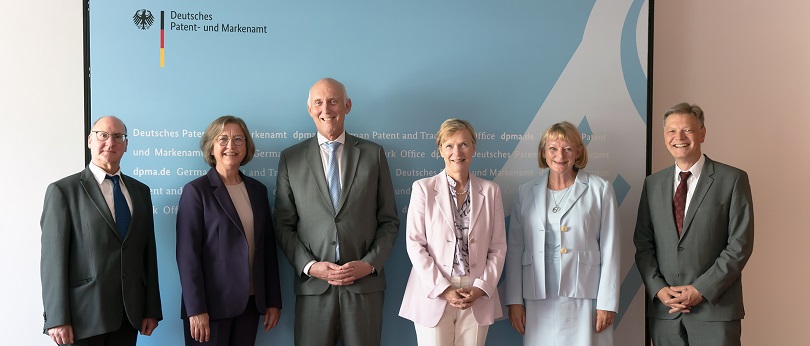
Working together for IP rights: Eva Schewior (3rd from right), Walter Schober (3rd from left), and other representatives of DPMA and THI.
Faster commercialisation of research results and innovations by means of patents – DPMA President: Technische Hochschule Ingolstadt with its Master’s course “Patent Engineering” as an ideal partner
Press release dated 02 July 2026
Munich. Turning technology-based research and development into marketable products and business models faster; protecting breakthroughs in fields such as quantum computing or artificial intelligence by means of patents and thus contributing to the sovereignty, competitiveness and prosperity of Germany: a new cooperation agreement between the German Patent and Trade Mark Office (DPMA) and Technische Hochschule Ingolstadt (THI) (European Metropolitan Region of Munich) emphasises the strategic relevance of IP rights – and brings IP know-how to companies. With its Master’s course “Patent Engineering”, Technische Hochschule Ingolstadt offers a unique study course in Southern Germany.
“IP rights are an indispensable instrument to commercialise research and development. They turn research results concerning future technologies into assets that can be sold at national and international level,” DPMA President Eva Schewior says. “The Master’s course ‘Patent Engineering’ in Ingolstadt is well known and has an excellent reputation throughout Germany. This makes Technische Hochschule Ingolstadt an ideal partner to make companies more aware of the strategic relevance of IP rights.”
Professor Walter Schober, President of Technische Hochschule Ingolstadt: “Patents and intellectual property play an important role if innovations are to find their way into practice. The cooperation with the DPMA gives us the opportunity to further integrate relevant knowledge into teaching, advanced training and transfer.”
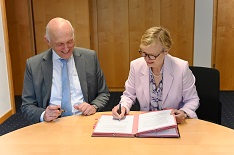
Eva Schewior and Professor Walter Schober signing the cooperation agreement
The cooperation between Technische Hochschule Ingolstadt and the German Patent and Trade Mark Office covers a broad range of topics. Experts of the DPMA are involved in events of the Master’s course “Patent Engineering” as well as in the Ingolstadt Patent Day, which is well known among experts throughout Germany. Furthermore, expert speakers from the DPMA contribute to additional expert meetings and information events at the university. Technische Hochschule Ingolstadt will receive extended search options in the DEPATIS database, which provides comprehensive patent documents. As part of the cooperation, it is also intended that the university will support the DPMA in imparting technical expert knowledge for the advanced training of its staff. In addition, Technische Hochschule Ingolstadt offers the patent examiners advanced technical and scientific training opportunities by allowing them to attend selected lectures and events. The two cooperation partners jointly develop, identify and use additional platforms to provide professional circles and the general public with information on IP-related issues.
A crucial factor: patent protection for technology-based innovations
Faster transfer of the results of top-class research to products and services! More spin-offs from universities on the basis of protected innovations! This is what Germany is consistently requested to do, for example by the Commission of Experts for Research and Innovation or by studies of the World Intellectual Property Organization (WIPO). As regards the transfer, an important step is the patent protection for innovations. The Federal Government’s High-Tech Agenda Germany, which promotes selected key technologies, has made this even more relevant. A faster commercialisation of technology-based innovations – this is the aim of the cooperation of the DPMA and Technische Hochschule Ingolstadt.
Patent engineers work at important intersections
Technische Hochschule Ingolstadt is part of the European Metropolitan Region of Munich – and, along with Berlin, one of two locations in Germany where students can take a patent engineering Master’s course. For example, the graduates work closely with developers, inventors and decision-makers in companies, universities and research institutions. Thus, patent engineers work at the important intersections of technology, IP management and strategy. This field is crucial to commercialising innovations by means of patents or utility models – and to helping the economy prosper.
In their companies and organisations, patent engineers promote and identify inventions and advise on IP rights and the economic potential of innovations. They are responsible for IP searches and individual patent applications as well as for an overall IP strategy.
Working together to encourage founders and start-ups to embrace IP rights
Technische Hochschule Ingolstadt’s offering targets not only students, PhD students and personnel, but also founders, start-ups und small and medium-sized enterprises (SMEs). The objective is to raise their awareness of, and provide them with training in, the necessary protection of future technologies.
The case of quantum technology: particular innovative power of small and medium-sized enterprises
Studies have shown that not even 10% of small and medium-sized enterprises in Europe use IP rights, although they have around 100 million employees in Europe and generate more than half of the European GDP. Statistical analyses carried out by the German Patent and Trade Mark Office showed that, in Germany, small and medium-sized enterprises are particularly often involved in innovations in quantum technology, for instance.
The German Patent and Trade Mark Office
Inventiveness and creativity need effective protection. The DPMA is the German centre of expertise for all intellectual property rights – patents, utility models, trade marks and designs. As the largest national patent office in Europe and the sixth largest national patent office in the world, our office stands for the future of Germany as a country of inventors in a globalised economy. Its staff of around 2,800 at three locations – Munich, Jena and Berlin – provide services to inventors and companies. They implement federal innovation strategies and develop the national, European and international protection systems.
Pictures: DPMA
Last updated: 2 July 2026
Not only protecting innovations
Social Media