Content
For Founders, Start-ups and SMEs: Free Intellectual Property Assessment
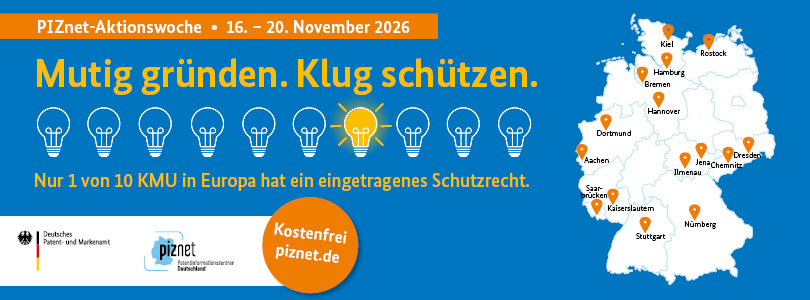
The German Patent and Trade Mark Office (DPMA) and PIZnet, the network of German Patent Information Centres, are offering individual consultations on patents, utility models, trade marks and designs from 16 to 20 November 2026 as part of Global Entrepreneurship Week Germany. Only one in ten SMEs in the EU makes use of intellectual property rights. Those seeking information will benefit from the experience gained through the DPMA’s Innovation Roadshow and its partners.
Press release of 5 November 2026
Munich/Berlin. A company name, a product design or a technical solution: almost every business owns intellectual property. Yet in the EU, only around one in ten small and medium-sized enterprises (SMEs) has a registered patent, trade mark or design.
This is precisely where the PIZnet Action Week comes in. From 16 to 20 November 2026, Patent Information Centres (PIZ) will dedicate two hours to addressing the specific needs and circumstances of each participating business. Free of charge.
The Action Week is part of Global Entrepreneurship Week Germany, which takes place from 16 to 22 November under the theme “Mutig. Gemeinsam. Machen.” (“Be Bold. Act Together. Make It Happen.”).
What Participants Receive Free of Charge
- A systematic two-hour initial assessment of intellectual property (IP) within their business
- An evaluation of the risks and economic opportunities associated with their current IP situation
- Guidance on potential gaps in IP protection and infringement risks, for example whether a planned company or product name might conflict with existing trade marks
- Strategic recommendations on how to make commercially effective use of intellectual property rights
- A written report outlining specific next steps
The consultations are intended to provide guidance and do not constitute legal advice.
Ask Early – Not Just When Problems Arise
“Many businesses only start thinking about intellectual property rights when a competitor copies their product or they receive a cease-and-desist letter over their company name. By then, their options for taking action are often already limited,” says Arne Krüger, Chair of PIZnet. “During the Action Week, we address these questions before problems arise. The consultations are impartial, take place locally and are free of charge.”
The DPMA and its partners’ Innovation Roadshow 2026, held in August and September, recently highlighted just how different the starting points are for individual founders, start-ups and SMEs. At eight stops from Berlin to Aachen, the focus was on practical questions: When does it make sense to protect inventions, trade marks or designs? When is it better to keep know-how confidential? What role do intellectual property rights play in financing and business partnerships? There is no one-size-fits-all approach to IP protection. Any strategy must be tailored to the business, its market and its business model. This is precisely why taking an individual look at a company's IP situation is worthwhile – and exactly what the PIZnet Action Week offers.
“The many conversations during our Innovation Roadshow have shown just how different companies’ starting points are – and, at the same time, how valuable it is to address their own intellectual property at an early stage. You don't need to have all the answers already. What matters is asking the right questions at the right time,” says Anne Fröhlich, Head of the DPMA’s Berlin Office, responsible for cooperation with Patent Information Centres and other partners.
Patents, Trade Marks and Designs: Significant Benefits for SMEs
In the EU, only one in ten SMEs makes use of intellectual property rights. Yet SMEs that hold registered IP rights generate, on average, 44 per cent more revenue per employee than comparable businesses without such rights. This is according to a joint study published in 2025 by the European Patent Office (EPO) and the European Union Intellectual Property Office (EUIPO). The findings are even more striking for founders: start-ups that file patent and trade mark applications during the seed or early growth stages are up to ten times more likely to secure investment.*
Why do so few SMEs take advantage of these opportunities? In a survey conducted by the EUIPO, businesses cite three main reasons: they see no added value, believe their ideas are not innovative enough, or lack knowledge of how intellectual property rights work. Addressing these barriers, providing comprehensive information and highlighting the options available: this is the shared goal of the DPMA and PIZnet during the Action Week from 16 to 20 November.
How to Book an Appointment
Visit  www.piznet.de, enter your postcode to find the nearest Patent Information Centre and book an appointment directly. Alternatively, you can register by email at info@piznet.de. The number of appointments available at each location is limited. Early registration is therefore recommended.
*Sources: EPO/EUIPO, Intellectual Property Rights and Firm Performance in the EU (January 2025); EUIPO, IP SME Scoreboard 2022; EPO/EUIPO, Patents, Trade Marks and Startup Finance (2023).
About PIZnet
PIZnet (Arbeitsgemeinschaft Deutscher Patentinformationszentren e. V.) is the network of 15 Patent Information Centres in Germany. The centres have been long-standing cooperation partners of the German Patent and Trade Mark Office (DPMA). They serve as regional points of contact for SMEs, start-ups and universities on matters relating to patents, utility models, trade marks and designs. They help businesses and institutions identify their intellectual property, make strategic use of IP rights and determine appropriate next steps.
The German Patent and Trade Mark Office
Inventiveness and creativity need effective protection. The DPMA is the German centre of expertise for all intellectual property rights – for patents, utility models, trade marks and designs. As the largest national patent office in Europe and the sixth largest national patent office in the world, it represents the future of Germany as a country of inventors in a globalised economy. Its approximately 2,800 employees at three locations – Munich, Jena and Berlin – provide services to inventors and companies. They implement the Federal Government's innovation strategies and further develop national, European and international protection systems.
Picture: DPMA and Prasert Krainukul/via Getty Images
Last updated: 5 November 2026
Not only protecting innovations
Social Media